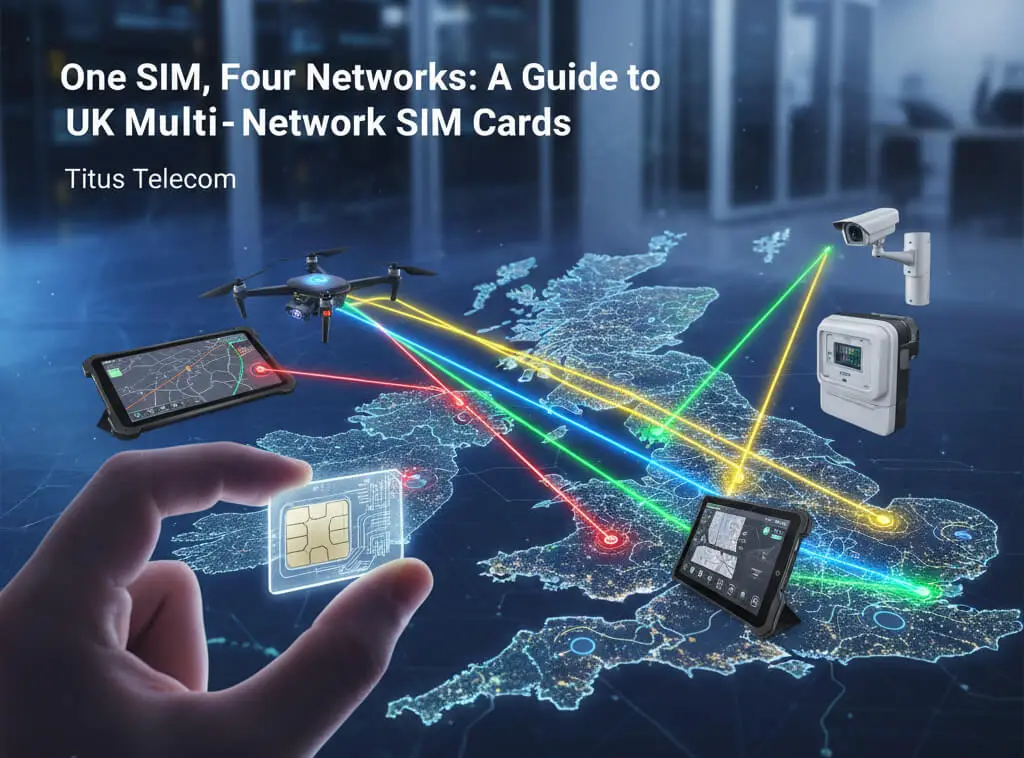
A multi-network SIM card provides access to several mobile networks from a single SIM, automatically connecting to the strongest available signal.
This technology is fundamental for businesses requiring consistent and reliable data connectivity for applications such as the Internet of Things (IoT), remote asset monitoring, and critical backup systems. This article explains the underlying principles of a multi-network SIM, its advantages over single-network alternatives, and its practical applications across various industries.
Understanding this technology is key to designing resilient and effective connected solutions.
In This Article:
-
What Is a Multi-Network SIM Card?
-
How Does a Multi-Network SIM Achieve Better Connectivity?
-
Which UK Networks Do These SIMs Use for the Best Coverage?
-
What Are the Key Differences Between a Multi-Network SIM and a Standard SIM Card?
-
Why Do Multi-Network SIM Cards Get Better Signal?
-
Are Multi-Network SIMs the Ideal Choice for IoT Devices?
-
Can a Multi-Network Data SIM Replace Fixed-Line Broadband?
-
What Industries Benefit Most from a Multi-Network IoT SIM Card?
-
How Is SIM Management Handled for Multiple Network SIMs?
-
How Do I Choose the Right Multi-Network SIM for My Business Needs?
1. What Is a Multi-Network SIM Card?
At its core, a multi-network SIM card, often referred to as a roaming SIM or a smart SIM, is a type of SIM that is not tied to a single mobile network operator. Instead of being locked to one provider, this one sim is pre-configured to connect to multiple mobile networks. It operates on an ‘unsteered’ basis, meaning it isn’t programmed to prefer one network over another. The sim intelligently scans the local environment for all available cellular signals and connects to the one offering the strongest signal.
This functionality is crucial for devices that are mobile or located in areas with inconsistent signal coverage from any single provider.
The primary purpose of a multi network sim is to maximise uptime and ensure a persistent data connection is maintained wherever possible. This type of sim essentially combines the coverage maps of several major networks into a single, more comprehensive footprint, allowing a device to connect to different networks rather than just one.
The technology enables devices to automatically and seamlessly switch between carriers without manual intervention.
If the primary connected network becomes unavailable or its signal degrades, the sim will initiate a search for the next best network and establish a new connection. This process ensures seamless connectivity, providing a level of resilience that a single network sim cannot match.
2. How Does a Multi-Network SIM Achieve Better Connectivity?
The enhanced connectivity offered by a multi-network sim card is achieved through roaming agreements. While traditional mobile phone users might associate roaming with using their phone abroad, the same principle is applied domestically within the UK. The sim is authorised to roam across all major UK networks, treating them as equal partners rather than a primary network and several secondary options.
When a device powers on, the multi-network sim inside scans for all detectable network signals.
It then assesses these signals based on strength and quality before connecting to the optimal available network. This is a dynamic process.
Should the device move, or if local network conditions change (for instance, due to congestion or a local mast fault), the sim can disconnect from the weakened network and re-connect to a stronger alternative. This ability to seamlessly switch networks is the fundamental advantage it holds.
This process ensures that devices can get signal in places where a single-network sim might fail entirely. For any business-critical application, whether it is a payment terminal, a security camera, or an environmental sensor, this resilience is paramount.
The objective is to eliminate the single point of failure associated with relying on one provider’s infrastructure.
3. Which UK Networks Do These SIMs Use for the Best Coverage?
To provide the most comprehensive service, a uk multi-network sim leverages the infrastructure of all the major mobile network operators. In the United Kingdom, this means having roaming agreements with the four networks: Vodafone, EE, O2, and Three.
By being able to connect to any of these providers, the sim effectively offers a combined coverage footprint that is far greater than any single operator can provide on its own.
Each of these uk networks has its own strengths and weaknesses in terms of geographical coverage. For example, one network might have excellent coverage in urban centres but be less reliable in rural Scotland, while another might have a more robust presence in remote coastal areas.
A multi network sim mitigates these individual shortcomings.
By having the ability to connect across multiple networks, a device is no longer dependent on the performance of a single provider in a specific location. It simply connects to whichever of the 4 networks offers the best coverage at that precise moment.
This ensures a more consistent and reliable service, which is particularly vital for static IoT devices deployed nationwide or for logistics and transport solutions that move through varied network environments. The goal is to provide the uk’s best possible coverage footprint from a single sim card.
4. What Are the Key Differences Between a Multi-Network SIM and a Standard SIM Card?
The primary distinction lies in network access. A standard sim card is issued by a specific Mobile Network Operator (MNO) and can only connect to that MNO’s network infrastructure.
If that network’s signal is weak or unavailable in a certain location, the device has no other option and will lose its connection. This creates a significant vulnerability for any application that relies on constant connectivity.
A multi-network sim, however, is network-agnostic. It is not locked to one provider and can connect to multiple networks. This flexibility is its core strength. On many occasions a multi network sim card will be the difference between your solution connecting to the internet or not.
Furthermore, a network sim designed for multi-network access offers superior resilience. Consider a scenario where a local mast for one provider goes down for maintenance. All single network sim cards relying on that mast will lose service.
A device with a multi-network sim will simply switch to a different provider’s mast in the area, often with no noticeable interruption in service. This failover capability is essential for critical applications.
5. Why Do Multi-Network SIM Cards Get Better Signal?
It is a common misconception that a multi-network sim itself has a more powerful antenna. The hardware is identical to a standard sim. The superior performance comes from its logical capabilities and the agreements that underpin it.
Multi-network sim cards get better signal coverage and bandwidth than single network sim cards because they are able to connect to multiple mobile networks rather than just one.
In practice, this means that in many places in the uk where only one of the four networks has signal or sufficient bandwidth to transit data so a multi network sim card makes perfect sense for remote deployments or where fixed broadband is not available.
The sim doesn’t boost a weak signal; it cleverly bypasses it by finding a stronger one from a different provider. It is this ability to choose the best network from a pool of options that results in a more reliable and robust data connection overall.
This network sim card makes perfect sense for applications where consistent uptime is non-negotiable. For example, in a vehicle tracking system, there are places a single network sim would lose signal, creating a blind spot in the data.
A multi-network sim significantly reduces the likelihood of such an event by switching providers as the vehicle moves through different coverage zones. For many businesses, this sim is more than a convenience; it’s a core component of service reliability.
6. Are Multi-Network SIMs the Ideal Choice for IoT Devices?
For the vast majority of Internet of Things (IoT) applications, a multi-network solution is not just beneficial, but often essential. IoT deployments can involve thousands of devices spread across a wide geographical area, many in remote or hard-to-reach locations.
Sending an engineer to swap a sim card because of poor local signal is impractical and expensive. An IoT SIM that can connect to any available network from the moment of installation removes this significant operational headache.
Many IoT devices, such as smart meters or agricultural sensors, transmit only small amounts of data. For these devices, the priority is not high speed but high reliability. The connection must be stable. A multi network sim card ensures this stable link, providing the necessary iot connectivity for the device to report its data reliably.
This makes the iot sim card a foundational component for scalable and manageable IoT projects.
Whether it’s for asset tracking, environmental monitoring, or industrial automation, the resilience offered by a multi-network sim is paramount.
The success of an IoT project hinges on the reliable flow of data from device to platform, and a multi network iot sim is specifically designed to ensure that flow is not interrupted by the limitations of a single mobile operator. A multi network sim is a powerful tool for iot deployments.
7. Can a Multi-Network Data SIM Replace Fixed-Line Broadband?
In certain scenarios, a multi network data sim is a highly effective alternative to traditional fixed-line broadband. While it may not replace a high-speed fibre connection for a data-heavy office, it is an excellent solution for many other use cases.
For example, it provides an immediate “day one” internet connection for new construction sites or retail pop-ups, long before a fixed line can be installed. This data sim card can be a primary solution connecting to the internet.
It also serves as a robust backup solution. Businesses that require uninterrupted internet access for critical operations can use a router equipped with a multi-network data sim for automatic failover.
If the primary fixed-line connection drops, the router instantly switches to the cellular network, leveraging 4G or 5G speeds to maintain business continuity. This data sim provides a resilient layer of protection against outages.
Furthermore, in rural and remote locations where fixed-line services are slow, unreliable, or entirely absent, a 4G or 5G-enabled router with a multi network sim can deliver a fast and stable internet connection.
The ability to use the strongest available mobile signal makes it a more dependable option than a solution tied to a single, potentially weak, network. The sim ensures the best possible performance the local cellular infrastructure can provide. A multi network sim card makes a significant difference in these situations.
8. What Industries Benefit Most from a Multi-Network IoT SIM Card?
A diverse range of industries leverage the reliability of multi-network connectivity. These are typically businesses that require a consistent data link for assets that are mobile, remote, or critical for operations.
Here are a few examples:
-
Logistics and Transport: For real-time vehicle tracking, fleet management, and in-cab communication systems. A multi network sim ensures vehicles remain connected as they travel across the country, passing through areas with varied network coverage.
-
Utilities and Energy: In the deployment of smart meters and grid monitoring sensors. These devices are often located in basements, dense urban areas, or remote rural locations, where the ability to find any usable signal is critical.
-
Retail and Payments: For mobile Point of Sale (PoS) terminals used at festivals, markets, or in pop-up shops. A reliable connection is essential for processing transactions, and a multi-network sim provides that assurance.
-
Security: To provide a primary or backup communication channel for intruder alarms and CCTV systems, ensuring that alerts and footage can always be transmitted.
-
Healthcare: For remote patient monitoring devices and sims for mobile health workers who need to access and update patient records from any location.
9. How Is SIM Management Handled for Multiple Network SIMs?
Managing a large estate of devices, each with its own sim card, presents a significant logistical challenge. This is addressed through a centralised SIM management platform.
These portals are designed to give businesses complete control and visibility over their entire portfolio of network sim cards from a single interface, regardless of which network each sim is currently connected to.
From the platform, administrators can perform a range of essential tasks. This includes activating or deactivating sims, monitoring data usage in real-time, setting up alerts for unusual activity, and diagnosing connectivity issues.
For businesses with devices deployed across the country, this remote management capability is invaluable, eliminating the need for costly and time-consuming site visits.
This centralised approach is particularly important for managing costs. Data plans can often be pooled across multiple sims, creating a more cost effective structure and preventing unexpected overage charges from individual high-usage devices.
Whether you have ten sims or ten thousand, a robust management platform is a critical component of any successful IoT or data connectivity deployment.
10. How Do I Choose the Right Multi-Network SIM for My Business Needs?
Selecting the appropriate multi network sim depends on several factors specific to your application. When buying a sim, the first consideration is data usage. An application that sends a small data packet once a day has very different requirements from a CCTV camera streaming video.
It is important to choose a tariff that provides the data you need without excessive cost, whether that involves preloaded data bundles, monthly allowances, or even an unlimited data plan for high-use cases.
The physical format of the sim is also important. Solutions are available in all form factors, from the standard plastic SIM (2FF, 3FF, 4FF) for routers and gateways to the embedded MFF2 chip sim for integrated designs where durability and security are paramount. The choice will depend on the hardware your application uses.
Ultimately, the ideal choice involves partnering with a provider that has deep expertise in IoT and data connectivity. A uk based provider can offer tailored advice on the best sim, tariff, and management platform for your specific project.
They can help navigate the complexities of deployment and ensure your solution is built on a foundation of reliable connectivity.
Summary of Key Points
-
Maximised Coverage: A multi-network sim uses the combined infrastructure of major providers like Vodafone, EE, and O2 to ensure the best coverage possible.
-
Enhanced Reliability: By automatically switching to the strongest available signal, the sim provides a resilient connection that is not vulnerable to a single network’s failure.
-
Ideal for IoT: The technology is perfectly suited for remote and mobile IoT devices, ensuring they remain connected to transmit critical data.
-
Flexible Applications: It can serve as a primary connection in places without fixed broadband or as a failover solution for business continuity.
-
Centralised Control: SIM management platforms provide the tools to monitor usage, control costs, and manage a large number of sims efficiently.
Next Steps
For businesses that require dependable data connectivity, exploring a tailored multi-network solution is a logical next step. To discuss the specific requirements of your IoT or data projects, please contact the team at Titus Telecom for a detailed consultation.